


I began work on this piece midmonth the same way I always do: with a central question I wanted to explore. I’m doing some significant process re-engineering at work and I have noticed that I’m rarely able to make big leaps. Instead, I go through a series of iterative, ever-widening hops until I finally reach the point where I think oh, this is where I wanted to be all along. So the question for this month was: ‘Why is it so hard for humans – even those deeply committed to change – to see things differently?’ I was circling around the idea that we carry internal maps of which we may not even be conscious, and we need to change those maps to change our thinking. I even had a working title: Unmapping.
This is not that essay.
I traveled to Philadelphia for the CampusESP Summit last week so I wanted an audiobook for the drive. It’s been a grueling last few months at work – anyone in enrollment can understand – so I decided to give myself a break from my ever growing to read list and select something instead that would be balm for my tired soul. I chose an old friend as my companion for the journey: Crossing to Safety, Wallace Stegner’s last novel. I’ve read it many times but this was my first time listening to it. For those unfamiliar with the book, it traces the history of the friendship of two academic couples from when they met as young faculty at the University of Wisconsin in the 1930s throughout the rest of their lives. It is a love song to the liberal arts and to the academy, and it asks important questions like what makes a good life? And in seasons of deep change, what endures?
As the miles flew by and I listened to Stegner’s elegant prose made even more resonant by hearing it aloud, I immersed myself again in the lives of Larry and Sally Morgan and Sid and Charity Lang. I travelled with them to Battell Pond, the Lang’s compound in Vermont that is a touchstone for both couples. As I explored the place through Larry’s recollections, I was transported to my own childhood trips to Maine to visit my grandparents at the cabin where they spent a month each summer.
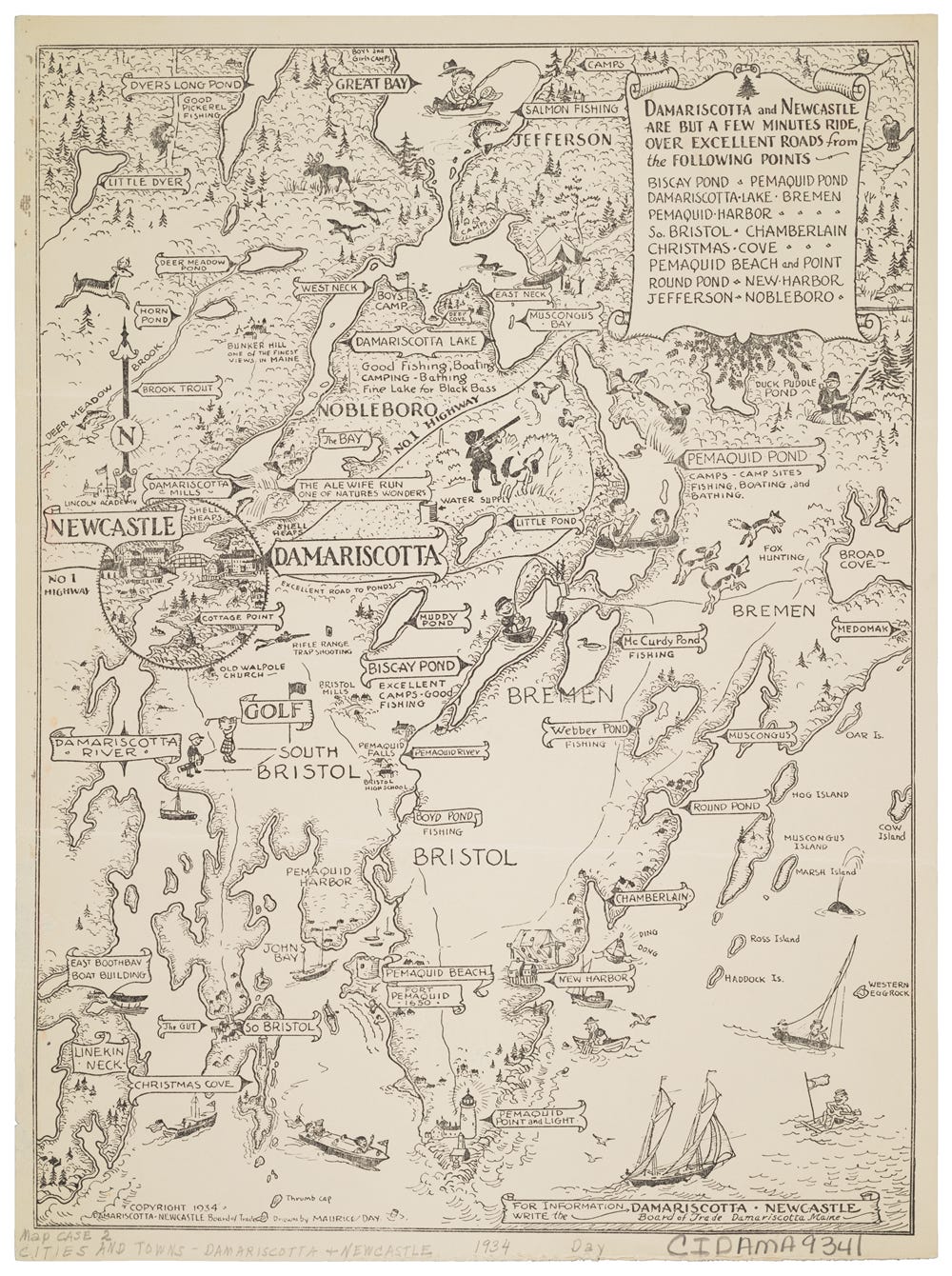
The rented cabin on Damariscotta Lake was simple: one floor, one bath, two bedrooms, a living room and a kitchen divided by a double-sided fireplace. There were bookshelves filled with old classics like Swiss Family Robinson. The cabin nestled in a grove of balsam at the edge of the lake, but the lakeside itself was cleared. There was an old stone outdoor hearth that we never used, a dock for my grandfather’s Boston Whaler, and a boathouse built from wood worn silver by age. Over the door to the boathouse was a whale carving which must have begun its life as a brilliant turquoise but which had weathered to a gentle sea-glass blue well before I encountered it for the first time.
I remember the smells and sounds of the place: the scent of linseed oil which permeated the cabin and which is instantly comforting to me to this day. The balsam tinged air, refreshing and heartening. The soft scup-scup-scup of the lake against the dock when the wind picked up. And the cry of the loons as they sang us to sleep, haunting and otherworldly.
The pace of the days was gentle. We spent long hours out on the lake using only the trolling motor, indolence punctuated by moments of intense activity when a largemouth bass would nibble on one of our lines. We read – books from the cabin’s bookshelf, and books from the local lending library which allowed summer people a seasonal card. We ate simple food but enjoyed old New England treats like penuche. There were occasional day trips like the once a year pilgrimage to Pemaquid Point Light, my favorite place on Earth, but for the most part we were contented to be home. And it was enough.
Looking back, I see that those days in Maine imprinted a map upon me. I learned that beauty need not be extravagant to be profound. That a day could be measured not by how much happened within it, but by how fully it was inhabited. That weathered things often possess a grace unavailable to things still trying to prove themselves. The cabin, the whale carving, the loons, the books, the lake itself - all were teaching lessons I would spend decades learning how to name.
The themes remain resonant today: simplicity, intentionality, and a belief that things which Time has distilled to their true essence hold a deeper beauty than anything flashy or new.
As I grew, my high-school self – deprived of Maine since my grandfather’s passing – crafted a vision of a good life. I remember saying emphatically that the only things I would need to be happy were good friends, good food, good music, and good books.
In the intervening years, I’ve joked about that, saying that 3 out of four isn’t bad. Those who know me in real life know that I am not a particularly social person, and the kind of deep and enduring friendship like Larry and Sally shared with Sid and Charity has mostly eluded me.
But now I wonder: what if my young self was wiser than I credited her?
Look at what I said earlier: I chose an old friend to accompany me on the journey. The concept was right; the lexicon was incomplete. I was thinking of friendship strictly in human terms. Yet some of the most enduring companions in my life have been books, ideas, places, and questions. A beloved novel returned to at precisely the right moment. A poem whose meaning unfolds slowly across decades. A memory waiting patiently for the next link in the chain that will illuminate why it mattered all along.
The friendship I imagined at sixteen may not have looked exactly as I expected. But perhaps I was describing something real nonetheless.
Kierkegaard said that life is a reality that can only be understood backwards but must be lived forward. So often in my life I have had the experience of something from memory arising and finally understanding why it mattered. Of recognizing it for the first time.
And so this essay is instead about recognition. Or more accurately, re-cognition: to know again. Stegner begins his novel with an excerpt from Robert Frost’s poem I Could Give All to Time:
I could give all to Time except—except
What I myself have held. But why declare
The things forbidden that while the Customs slept
I have crossed to Safety with?
And so the central question I now ask is this: When facing or creating change, how do we know which parts of our maps need deeper understanding, and which need revision?
I don’t have an answer to that question. But I take comfort in the words of my old friend Rilke in Letters to a Young Poet:
Be patient toward all that is unsolved in your heart and try to love the questions themselves, like locked rooms and like books that are now written in a very foreign tongue. Do not now seek the answers, which cannot be given you because you would not be able to live them. And the point is, to live everything. Live the questions now. Perhaps you will then gradually, without noticing it, live along some distant day into the answer.
Perhaps that is why this essay remains unfinished.
I began wanting to understand why it is so difficult to think differently. Instead I found myself reflecting on books, places, friendships, and the quiet recognition that some truths arrive in our lives long before we possess the language to understand them. I have come to suspect that not every map requires revision. Some require only a deeper reading.
And too: there are surely other maps I carry whose significance I have not yet recognized. Meanings I have inherited but not fully understood. Questions I am still living.
If Rilke is right, perhaps that is as it should be.
Credits:
We shall not cease from exploration
And the end of all our exploring
Will be to arrive where we started
And know the place for the first time.
TS Eliot: Little Gidding, last of the Four Quartets
Map image: 1934 map of the Damariscotta–Newcastle region, courtesy of the Maine State Library's DigitalMaine collection.
Søren Kierkegaard: The observation that "life can only be understood backwards; but it must be lived forwards" comes from his journals and papers and is quoted in numerous translations.
Robert Frost: I Could Give All to Time, Yale Review, 1941
Rainer Maria Rilke: Letters to a Young Poet (translated by M. D. Herter Norton); available online via Project Gutenberg Canada
Sarah, your eloquent expression is so wonderful! Keep writing from your heart and your mind, both of which are truly a gift.